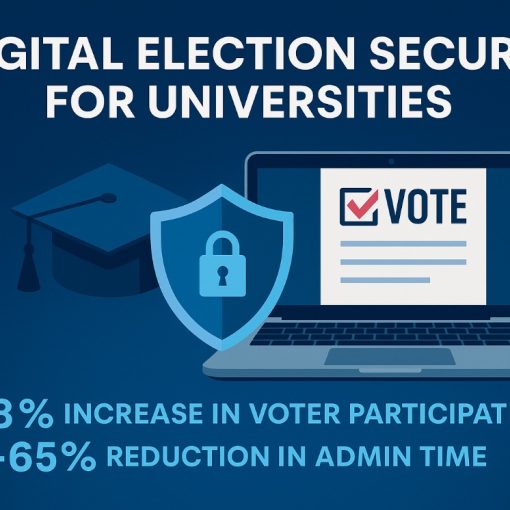
Walk into any conversation about election integrity in 2026 and you will quickly hit a strange contradiction. Most experts will tell you that internet voting is not safe enough for high-stakes public elections. In the same breath, those same experts will admit that more of the election machinery, from voter registration to results reporting to ballot tracking, already runs on the internet. The honest question is not whether digital systems belong in democracy. They already do. The real question is whether we are designing them with the seriousness the moment demands.
This year is forcing that question into the open. As state and local governments prepare for the U.S. midterms, security officials are bracing for a threat landscape that looks very different from 2020 or even 2024. AI-generated phishing, deepfaked official communications, and automated social engineering are now routine. The pressure points are not just the ballot box. They are the registration database, the poll worker email inbox, the results website at 9 p.m. on election night. If e-voting is going to mature, it has to mature in that context.
The new threat model: less about the vote, more about the infrastructure
For years, the public debate about secure online voting fixated on a single nightmare scenario: a foreign actor flipping ballots inside a server. That risk still matters, but it is no longer the most likely path to disruption. The modern adversary is more interested in eroding trust than rewriting tallies. Take down a results portal for ninety minutes on election night, and you do not need to change a single vote to fuel a week of conspiracies.
This is why the smarter election technology vendors are quietly rebuilding their stacks around resilience rather than just confidentiality. Multi-factor authentication for voters is the floor, not the ceiling. Rate limiting, anomaly detection on registration lookups, and signed audit logs for every administrative action are becoming the new baseline. None of this is glamorous. All of it is overdue.
Cryptographic verification stops being a buzzword
The most encouraging shift in 2026 is the slow, real move from marketing language to actual implementation when it comes to end-to-end verifiable voting. For a long time, vendors used phrases like “blockchain-based vote recording” the way restaurants use the word “artisan,” mostly for atmosphere. That is changing. Serious online election platforms now publish their cryptographic protocols, let independent researchers test them, and give voters a tracking code they can use to confirm their ballot was recorded as cast and counted as recorded.
That third property, counted as recorded, is the one that matters. Plenty of systems can show a voter that their ballot reached the server. Far fewer can prove, mathematically, that the final tally includes it correctly without revealing how the person voted. Cryptographic vote verification systems built on homomorphic encryption and mix networks are finally crossing the line from academic paper to production deployment. Platforms like OnlineVotingApp, which build end-to-end verifiable voting into their core rather than bolting it on later, are setting a pattern that the rest of the industry will have to follow.
Accessibility is a security feature, not a sidebar
Here is a point that gets lost in the security debate: a voting system that cannot be used by everyone is not actually secure. It just pushes the failure into a different column. If voters with visual impairments, voters overseas, voters with mobility limitations, or voters in remote areas cannot complete a ballot independently, the system has failed its first test, regardless of how strong its TLS configuration is.
Accessible voting systems used to be treated as a compliance checkbox. In 2026, they are being recognized as a load-bearing part of the trust model. When more eligible voters can participate without friction, the legitimacy of the result strengthens. The good news is that the technology has caught up. Screen reader compatibility, large-print interfaces, voice navigation, and translated ballots are no longer expensive add-ons. They are table stakes for any platform that wants to claim it supports digital democracy.
Where blockchain actually earns its keep
Skepticism about blockchain in voting is justified. Putting raw ballots on a public ledger does not solve secrecy, and most of the early pilots were solutions in search of a problem. But there is a narrower use case where distributed ledgers are quietly proving their worth: tamper-evident logging of administrative actions and aggregate tallies. If every change to a voter roll, every ballot batch acceptance, and every recount trigger is written to an append-only ledger that auditors can independently verify, the entire chain of custody becomes much harder to dispute after the fact.
That is a much humbler claim than “blockchain voting,” and it is also far more defensible. The most credible online election platforms are using these techniques for audit trails and ballot batch attestation, not for the secret ballot itself. That distinction matters and is one of the cleanest signals of a vendor that actually understands the threat model.
Transparency as a competitive advantage
The voting technology vendors who will survive the next decade are the ones who treat transparency as a feature, not a liability. Publishing source code for review, releasing post-election audit reports, and inviting independent red teams used to be seen as risky. Today, it is the opposite. Opacity is the risk. Voters, regulators, and journalists are no longer satisfied with a vendor saying “trust us.” They want to see the math, the logs, and the test results.
This shift has real implications for how procurement decisions get made. Election administrators evaluating secure voting software in 2026 are asking pointed questions: Can you show me your last penetration test report? Who has reviewed your cryptographic protocol? How does your platform handle a coordinated denial of service attempt during ballot return? The vendors who can answer those questions cleanly are pulling ahead. The ones who cannot are losing contracts.
The road ahead
The future of voting is not a single product or protocol. It is a layered system where paper, cryptography, accessibility, and rigorous audit all reinforce each other. Internet voting will continue to expand cautiously, especially for overseas voters, military personnel, and union or shareholder elections where the risk profile is different from a national race. The high-stakes public election in most jurisdictions will still depend on a paper trail and post-election audits, and that is the right call for now.
But the trajectory is clear. As cryptographic verification matures and end-to-end verifiable voting systems prove themselves in lower-stakes elections, the case for cautious expansion gets stronger every cycle. The platforms that will lead this next phase are the ones treating voter security, transparent election administration, and accessibility as one connected problem rather than three separate checkboxes. 2026 is the year that distinction stops being theoretical and starts deciding which vendors get to stay in the room.
Election integrity is no longer something we inherit. It is something we have to build, audit, and rebuild every cycle. The sooner the industry accepts that, the better positioned digital democracy will be for whatever the next decade brings.