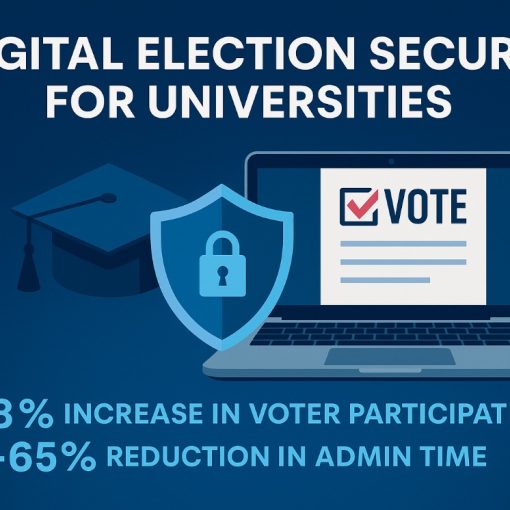
The 2026 Election Security Paradox: Why Trust in Digital Democracy Hinges on What Voters Cannot See
Every election cycle brings a familiar ritual. Officials reassure the public that voting systems are safe. Researchers warn that they are not safe enough. Voters, caught in the middle, are asked to trust a process they rarely understand. The 2026 midterm elections are unfolding under unusually heavy pressure, and the conversation about secure online voting has shifted from a fringe debate into the heart of how governments think about democratic legitimacy.
What makes this year different is not a single breach or a sudden technological leap. It is the quiet, accumulating recognition that election integrity now depends on layers of infrastructure that almost no voter ever sees. The locks have changed, the threats have changed, and the standards by which we judge voting technology need to change too.
The Hidden Architecture of a Modern Election
For most of the twentieth century, election security was a physical problem. Ballots were paper. Tabulation was mechanical. Chain of custody could be enforced with a padlock and a watchful poll worker. None of that has gone away. In fact, 96 percent of voters this year will cast ballots with a voter-verifiable paper trail, and 49 states will conduct some form of post-election audit.
But behind that paper sit voter registration databases, electronic pollbooks, results reporting websites, and the networks that connect them. These systems are not the ballot itself, but they shape every step around the ballot. If a registration database is corrupted, voters arrive to find themselves missing from the rolls. If a results reporting site is tampered with, public confidence collapses long before any official certification. The 2026 environment forces election officials to defend a perimeter that did not exist a generation ago.
AI Has Changed the Threat Surface
The Brennan Center’s most recent survey of local election officials describes a landscape transformed by artificial intelligence. Social engineering attacks are more convincing. Phishing emails sent to county clerks no longer carry the telltale grammatical errors of the past. Deepfake audio impersonating election directors has already been used to test internal verification procedures. AI does not need to break encryption to break trust, it only needs to convince one tired staffer to click one link.
This is why so much attention has shifted toward endpoint detection, network segmentation, and identity verification. The work is unglamorous. It does not produce headlines. But it determines whether a small jurisdiction with three full-time employees can withstand an attack that would have been state-sponsored and rare just a decade ago.
Where Online Voting Fits Into the Conversation
It would be dishonest to pretend that the scientific community has reached consensus on internet voting. The opposite is true. Major research bodies continue to argue that public elections should not be conducted over the open internet, citing risks that range from malware on voter devices to undetectable server-side manipulation. That position deserves to be taken seriously, and any responsible discussion of voting technology has to start there.
At the same time, the practical reality is that millions of voters already cast ballots remotely. Military and overseas voters depend on electronic transmission. Voters with disabilities often have no accessible alternative to digital ballot marking. The question is not whether digital tools will touch the voting process. They already do. The question is whether the tools used for those narrow populations are governed by the same rigor as the rest of the election infrastructure.
What Real Verification Looks Like
This is where end-to-end verifiable voting systems matter. End-to-end verification gives each voter a way to confirm that their ballot was recorded as cast and counted as recorded, without exposing how they voted. Cryptographic vote verification has matured significantly over the last decade, and pilot programs in several countries now demonstrate that mathematical proofs can supplement, rather than replace, the physical audit trails Americans rely on.
Multi-factor authentication for voters, when paired with cryptographic verification, raises the floor of what a remote voting system must achieve. The traditional username and password approach is no longer defensible for any system that touches an election. Modern secure voting software treats voter authentication the way banks treat large transactions, with layered checks that can flag anomalies before a vote is ever submitted.
Accessibility Is Not a Side Conversation
One of the most consistent blind spots in election security debates is the treatment of accessibility as a secondary concern. It is not. A voting system that cannot be used independently by a blind voter, a voter with limited motor function, or a voter who reads at a different grade level has failed at its primary job, regardless of how well it resists external attack.
Accessible voting systems are not charity. They are the proof that a democracy works for the people who actually live in it. The most promising work in this space pairs accessibility features directly with security features, treating both as non-negotiable. When platforms are designed this way from the start, the costly retrofitting that has plagued previous generations of voting technology disappears.
The Trust Layer
If there is one lesson from the last several election cycles, it is that technology alone does not produce trust. Procedures produce trust. Transparency produces trust. The willingness of officials to explain, in plain language, what protections exist and where the limits are, produces trust.
This is why transparent election administration matters as much as any cryptographic tool. A voting platform that publishes its audit logs, undergoes independent review, and complies with current election security standards gives voters something they can verify, or at least point to. A voting platform that operates as a black box invites suspicion no matter how strong its underlying code may be.
What Comes Next
The next twelve to twenty-four months will be telling. Federal funding for state and local election offices has been uneven, with 75 percent of local officials reporting that they have not received additional resources to offset recent cuts. That gap will be filled, one way or another, by private vendors, by volunteer technical communities, or by quiet improvisation at the county level.
The voting technology that earns public confidence in this environment will share a few traits. It will be auditable from the outside, not just from within. It will treat accessibility and security as one problem, not two. It will assume that AI-driven attacks are the baseline, not the exception. And it will be honest about its limits, because election integrity is built on what a system can prove, not on what it claims.
Digital democracy is not a destination. It is a discipline. The work happening right now, in county offices and research labs and standards committees, will decide whether voters in 2028 inherit a stronger system or merely a more complicated one.