A Silent Divide on Election Day
Every election — whether it’s for a university council, a housing society, or a professional association — hides a quiet divide.
On one side are the young: digital natives, quick to adapt, confident with screens.
On the other side are the veterans — those who’ve seen elections before computers even existed.
And when organizations move to online voting, that divide suddenly becomes visible.
For the younger group, it’s effortless. For the older ones, it can feel like democracy is slipping behind a login screen.
Change Isn’t Always Comfortable
During a local cooperative’s first online election last year, an elderly member called the helpdesk in a panic:
“I clicked submit, but the screen went blank! Did I just lose my vote?”
She hadn’t. The system had processed her ballot perfectly. But her anxiety was real — it came from decades of associating “a real vote” with “paper in a box.”
Moments like that remind us that progress isn’t just about better systems; it’s about bringing people along with those systems.
The Emotional Journey of Digital Adoption
Online voting isn’t only a technological shift — it’s a psychological one. It asks people to:
- Trust an invisible system.
- Believe their single click has the same weight as a paper ballot.
- Accept that democracy now lives inside a screen.
That takes courage.
But when done right, it also unlocks something remarkable — inclusion. People who once stayed out because of distance, health, or logistics can finally take part.
A Case from a Teachers’ Federation
A teachers’ federation in southern India moved to online elections during the pandemic. Initially, half the senior members resisted. They didn’t trust “digital voting.”
The organizers decided not to argue — they demonstrated. A 20-minute live session showed how 2FA worked (password + OTP), how each device could only be used once per voter, and how results were verified instantly.
By the end of the session, one of the senior-most teachers smiled and said,
“I didn’t realize it could be this simple. Maybe it’s time we stop fearing change.”
That election saw 96% turnout, the highest in the federation’s history.
The Role of Design in Building Confidence
Technology doesn’t need to look intimidating. A friendly interface, clear instructions, and simple prompts can do more to calm anxiety than any technical explanation.
OnlineVotingApp.com’s team learned that small design touches — like showing a green tick after each successful step or displaying “Your vote has been recorded securely” at the end — helped new users feel reassured.
Democracy thrives not when systems are complex, but when people feel safe using them.
Generations Learning from Each Other
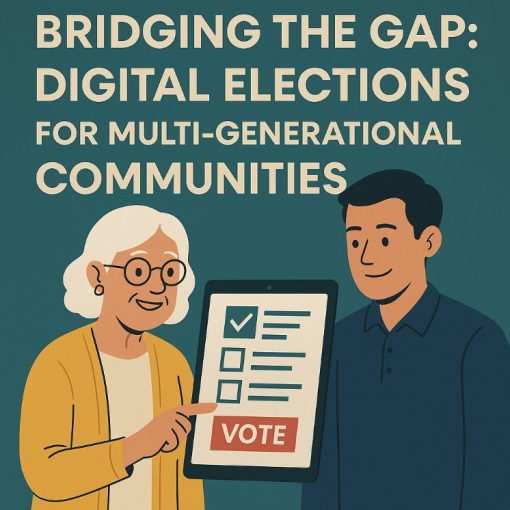
Interestingly, in many organizations, younger members become natural guides.
In college alumni elections, it’s common to see graduates helping their professors navigate the system.
In professional bodies, tech-savvy members often volunteer to assist seniors during login or verification.
It becomes more than just voting — it becomes a shared moment of learning.
That’s the human beauty of technology: it connects people who might otherwise never talk.
When Convenience Meets Inclusion
Online voting isn’t just convenient; it’s empowering.
It lets a retired member in a remote town, a working parent with no time to travel, and a young student abroad all participate equally.
In one global NGO election, members from 45 countries voted within 48 hours. Many had never participated before — not because they didn’t care, but because logistics had always been the barrier.
When barriers disappear, participation soars. And with participation comes renewed trust in leadership.
Overcoming Resistance with Empathy
Every digital transition faces resistance. The answer isn’t persuasion through jargon — it’s empathy.
Show people how it works. Let them try it in a mock vote. Offer real-time help. Publish guides with screenshots. Be present.
The first time someone successfully votes online, that small moment of confidence ripples outward — it builds the kind of trust no marketing campaign ever could.
The Future: A Blended Democracy
The future of elections won’t be purely digital or purely manual — it’ll be blended.
Some will still prefer in-person polling; others will demand mobile access.
And that’s perfectly fine.
Technology shouldn’t erase tradition; it should expand it.
It should make participation possible for everyone, not just the tech-savvy.
Conclusion: Democracy Belongs to Everyone
At its heart, voting — whether by paper, machine, or phone — is about being seen and heard.
Online voting, done thoughtfully, doesn’t replace that feeling; it extends it. It turns distance into inclusion, fear into curiosity, and confusion into connection.
Because in the end, it’s not about software. It’s about people — old and young, near and far — united by one simple belief:
their voice still matters.