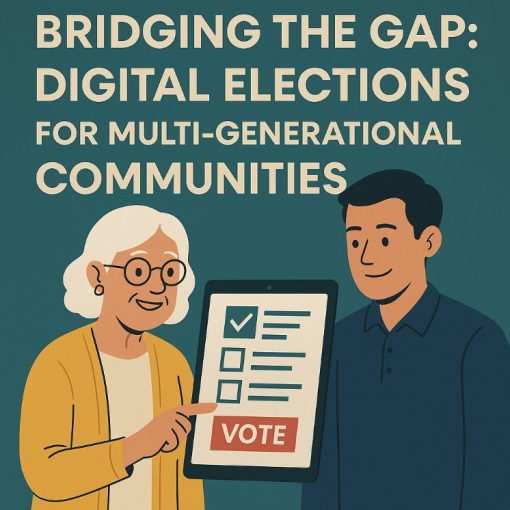
A World in Election Turmoil
If there was ever a time when the world collectively felt the strain of outdated election systems, it was between 2024 and 2025. From long queues in India to recount controversies in the U.S., to extreme weather disrupting polling in Southeast Asia, one thing became painfully clear: the way nations vote has not kept up with the way nations operate.
In the same decade where almost everything from national ID verification to tax filing to financial transactions has moved seamlessly online, the election booth remains stunningly analog. And that mismatch is starting to show cracks.
The truth is uncomfortable but undeniable:
Voting is still too inconvenient for the modern citizen. And too fragile for the modern world.
Whether it’s a cyber threat in Europe, postal ballot delays in the U.S., or heatwave disruptions in Australia, the pattern is always the same elections remain vulnerable, slow, and dependent on immense human effort.
But what if technology isn’t the threat, but the solution?
The Shift: From Analogue Ritual to Digital Civic Participation
Ten years ago, digital voting sounded like a futuristic concept. Today, it sounds like common sense.
Think about it:
Millions of people securely complete banking transactions, sign binding agreements, apply for visas, access health records, and manage corporate shareholding online. Entire stock markets move trillions daily on encrypted digital rails.
Yet voting arguably the single most important civic activity requires people to physically stand in line, show outdated ID documents, and trust a chain of manual handling that has countless points of failure.
When you compare election systems to modern services, the gap is startling.
That’s why governments, universities, corporations, cooperatives, and civil groups worldwide are exploring the move toward digitized, authenticated, secure online voting systems.
It isn’t trend-driven.
It isn’t political.
It’s practical.
What’s Driving This Sudden Global Urgency?
1. Record Voter Fatigue and Urban Migration
People today don’t always live where they are registered. Students migrate for internships. Professionals switch cities for jobs. Families relocate frequently.
Offline voting systems are rooted in a world where people stayed in one place for decades.
That world no longer exists.
Digital voting solves this by allowing secure identity-based authentication instead of location-based polling.
Platforms like OnlineVotingApp.com use two-factor authentication (password + OTP) so voters can participate from wherever they are without compromising security.
This is huge in regions with volatile migration India, the U.S., UAE, Singapore, Europe.
2. Climate Disruptions
In 2024, several Asian cities recorded heat indices above 50°C. Standing in line for 2–3 hours was not just uncomfortable it was dangerous.
Flooding, cyclones, blizzards, wildfires… the climate reality is harsh.
Democracy should not depend on weather conditions.
Digital voting acts as an equalizer people can participate safely, without exposure to extreme conditions.
3. Election Staffing Shortages
Countries like the U.S., UK, and Japan have an aging population. Recruiting enough poll workers is becoming difficult.
Meanwhile, high-density nations like India require millions of temporary staff, security personnel, and on-ground logistics teams.
Digital voting doesn’t replace humans but it reduces dependence on a massive temporary workforce.
Instead of 100 people managing one district, a handful of trained administrators can manage an entire election remotely.
The Misunderstood Part: Security Concerns Are Shifting, Not Growing
One of the biggest misconceptions is that digital voting introduces security risks. But the real story is this:
Digital risks are visible, measurable, and fixable.
Offline risks often aren’t.
Ballot stuffing
Late-night counting manipulation
Bogus postal ballots
Human error
Tampered boxes
Fraud at booth level
These are old problems we pretend are under control.
With digital systems, security becomes auditable, not just assumed.
OnlineVotingApp.com uses a device-level voter lock (“One Voter, One Machine”) which stops the most common form of vote manipulation multiple voting attempts using different devices or spoofed identities.
When combined with digital audit trails and encryption, you get a system that can detect and block suspicious behavior in real time something impossible with paper ballots.
Case Study: Elections That Went Wrong And What They Teach Us
🇺🇸 The U.S. Presidential Cycle (2020–2024)
Regardless of political leanings, one fact is universal:
slow results lead to speculation, and speculation leads to distrust.
Weeks of legal battles, recounts, and accusations did more damage to public confidence than the actual outcome.
Had voter authentication and counting been automated, the delays and the distrust they caused would have been dramatically reduced.
🇵🇭 The Philippines Automated Elections
Here, automation improved trust.
The introduction of secure digital counting machines cut fraud accusations significantly and reduced the tallying time from days to hours.
The lesson?
Digital systems, when transparent, increase trust.
🇪🇪 Estonia’s 20-Year Experiment with Online Voting
Estonia runs one of the world’s most successful online voting systems for national elections.
With identity cards, encrypted ballots, and public code audits, they vote online with confidence.
What does this show?
Digital voting is not theoretical. It’s operational.
The Role of Dedicated Digital Platforms in This Shift
Digital voting isn’t a website.
It’s a full-stack system.
The reason platforms like OnlineVotingApp.com are becoming widely adopted in universities, companies, councils, cooperatives, and associations is because they solve multiple problems at once:
- end-to-end management reduces administrative chaos
- voters authenticate securely using multiple checks
- results are instant and tamper-proof
- dedicated support helps non-tech-savvy participants
- the interface feels friendly enough for all age groups
- device locking prevents rigging attempts
When these capabilities blend into a single ecosystem, elections feel modern, fast, transparent, and trustworthy.
This is not “technology replacing democracy.”
It’s technology reinforcing it.
Why the Future Will Be Hybrid Not Fully Digital at First
Most countries will not jump to national-level online voting immediately.
They’ll start with:
✔ internal party elections
✔ university elections
✔ professional associations
✔ cooperatives
✔ shareholder meetings
✔ chamber of commerce polls
✔ housing society elections
This is already happening worldwide.
The hybrid era will teach voters and policymakers that digital systems can be secure, accessible, and verifiable.
A More Resilient Election System for the Next Decade
If 2024–2025 taught us anything, it’s that elections are fragile when the process relies too heavily on physical logistics.
Digital voting doesn’t eliminate all challenges but it creates a buffer against the biggest vulnerabilities:
- weather
- mobility
- manpower shortages
- counting delays
- local-level tampering
- logistical bottlenecks
And that buffer is exactly what modern democracies need.
Conclusion: Democracy Deserves Upgrading
The world is not rejecting democracy.
People are rejecting inconvenient democracy.
Digital voting isn’t an experiment anymore.
It’s a response to real, urgent, global challenges that outdated systems can no longer withstand.
The question is no longer “Should we adopt digital voting?”
But “How soon can we make elections accessible, resilient, and future-ready?”
Platforms like OnlineVotingApp.com are not selling technology.
They’re selling the possibility of a smoother, more inclusive democratic experience.
And if global events continue the way they have… digital democracy may not just be the future.
It may be the only sustainable path forward.