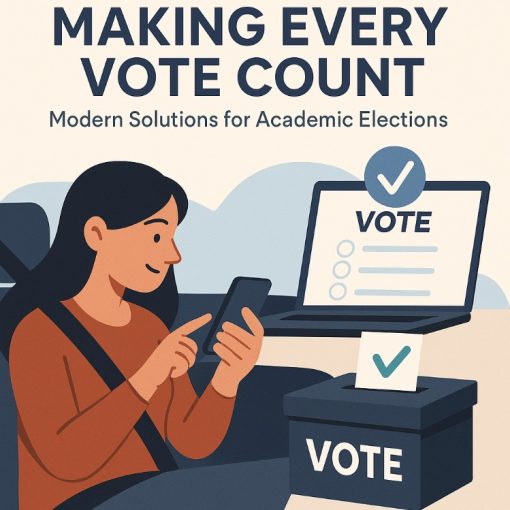
The End-to-End Verifiable Voting Revolution: Securing Democracy in the Digital Age
In 2026, a crucial paradox defines election security worldwide: 96% of voters cast ballots with voter-verifiable paper trails, yet demand grows for accessible online voting options. Election officials face a fundamental tension – how do you expand voting access through technology while maintaining the security standards that voters expect? The answer lies in end-to-end verifiable voting systems, a cryptographic advancement that’s quietly reshaping how democracies think about secure elections.
The Crisis in Election Infrastructure
America’s voting infrastructure is aging. Most states operate electronic voting and tabulation systems that are at least a decade old, many no longer manufactured. Finding replacement parts has become an unconventional treasure hunt for election officials nationwide. Meanwhile, younger voters consistently prefer digital interaction modes, yet security experts remain cautious about internet voting. This creates an uncomfortable reality: the systems meant to serve accessibility and convenience haven’t earned the trust they need.
Internet voting remains fundamentally insecure by scientific consensus. Email voting, mobile voting apps, and unverified digital systems introduce attack vectors that paper ballots simply don’t have. But dismissing digital voting entirely ignores a critical truth – some voters cannot access polling places, and others desperately want voting options that fit their lives. The path forward isn’t choosing between security or accessibility. It’s redesigning how digital voting works from the ground up.
What Makes Voting Truly Verifiable?
End-to-end verifiable voting (E2E-V) represents a paradigm shift. Unlike traditional online voting where voters must trust software they cannot see, verifiable systems give voters cryptographic proof that their vote was recorded correctly and counted as cast. Here’s how it works: voters receive a unique encryption code, cast their vote digitally, and can later verify that their encrypted vote appears on the official ballot roster without exposing how they voted.
This isn’t theoretical. Estonia has been running E2E-V election pilots successfully. Blockchain-based vote recording systems are being deployed in municipal elections. Companies developing secure online voting platforms are now building these verification layers directly into their infrastructure, making transparency a technical requirement rather than a policy hope.
The approach addresses the fundamental flaw in traditional online voting: voters have zero way to verify their vote was actually recorded as intended. With E2E-V systems, even if a hacker compromises the voting server, the attack becomes mathematically detectable. Voters can verify their vote without exposing it to election officials or observers.
Accessibility Meets Cryptography
Here’s where the elegance emerges. Accessible voting for all demographics was always supposed to be a feature, yet digital accessibility and security felt like opposing forces. Electronic voting systems with end-to-end verification flip this equation. Voters with visual impairments can use screen readers and high-contrast interfaces without sacrificing vote secrecy. Remote voters with mobility challenges can vote from home with the same cryptographic proof of integrity as in-person voters.
Secure online voting platforms are evolving to include multi-factor authentication, ensuring that only eligible voters can access the ballot, while verification codes ensure transparent election administration. Each layer builds on cryptographic standards rather than hoping users trust a black-box application.
The Reality Check
Security researchers haven’t abandoned their skepticism, and that’s appropriate. They’ve identified genuine risks – voter coercion through vote-selling, malware on personal devices, and attacks against the voter-facing interface. These are real challenges, not myths.
But the evolution toward verifiable systems suggests the conversation is shifting from “is online voting secure?” to “what level of security can we build?” Compliance with election security standards now includes verifiability requirements. New frameworks like VoteSecure and similar technologies are addressing coercion-resistance through clever cryptographic designs that make vote-buying mathematically harder.
The Future of Democratic Access
The 2026 election cycle is revealing something important: election officials are tired of pretending paper-only or digital-only are the only options. Hybrid approaches are emerging – secure voting software that produces voter-verified paper ballots, blockchain-based recording for transparent administration, and E2E-V cryptography for those who vote remotely.
This isn’t a race to eliminate paper ballots. It’s recognition that modern democracy needs multiple secure pathways. Younger voters who prefer digital interaction can vote with cryptographic verification. Voters who trust paper can hand over a ballot they marked themselves. Election administrators get transparency through blockchain recording and mathematical auditability. Everyone gets the security confidence the current crisis demands.
The transformation from aging electronic systems to verifiable voting architectures represents more than technological upgrade. It’s a recognition that election security and voter access aren’t actually in conflict when you design systems correctly. Cryptography, transparency, and accessibility aren’t competing values – they’re the foundation of 21st-century democratic infrastructure.
Democracy in 2026 isn’t about choosing between paper and digital. It’s about choosing systems where every voter can verify, every ballot can be audited, and every voice counts with technical certainty.