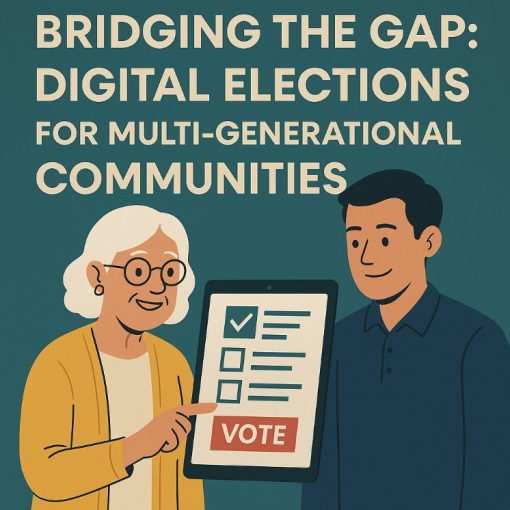
The American public has developed a curious confidence in electronic voting systems, even as cryptographers and election security experts continue to warn that internet voting remains fundamentally insecure. This paradox came into sharp focus in May 2026 as a new open-source mobile voting protocol called VoteSecure launched, promising to finally deliver the secure digital voting systems that have eluded politicians and technologists for decades.
But the fundamental question remains unchanged: can technology actually fix what’s broken in American democracy, or are we racing toward a dangerous normalization of voting methods that security researchers say cannot be adequately protected?
The Trust Gap in E-Voting Security
Recent polling reveals a troubling disconnect. More than 80 percent of American voters express confidence in electronic voting systems, according to 2026 election surveys. Yet computer scientists working in election security maintain an overwhelming consensus that internet voting is inherently insecure and likely to remain so for the foreseeable future. This gap between public perception and expert assessment represents one of the most significant challenges facing the future of digital democracy.
The issue isn’t complacency. It’s that most voters have never experienced a direct attack on their vote, and the infrastructure that protects electronic voting systems remains largely invisible to them. When something works consistently without visible problems, trust grows naturally. But election security experts understand something the public doesn’t: the absence of detected attacks doesn’t mean attacks haven’t occurred.
VoteSecure: Innovation Meets Skepticism
In May 2026, Bradley Tusk’s Mobile Voting Foundation, working with the cryptography firm Free & Fair, announced VoteSecure, an open-source software development kit designed specifically for secure mobile voting. The protocol incorporates advanced cryptographic concepts like end-to-end verifiable voting, homomorphic tallying, and Benaloh challenges. It represents a genuine technological advancement in the e-voting space, with $20 million invested in development.
VoteSecure will be tested in actual elections beginning with Anchorage, Alaska’s 2026 city assembly and school board races, and Adams County, Colorado. These aren’t hypothetical experiments. Real voters will use their smartphones to cast ballots in real elections. The stakes, while lower than federal races, are nonetheless real.
Yet even as VoteSecure launches with legitimate cryptographic improvements, security experts like Andrew Appel at Princeton University remain unmoved. His position is unequivocal: voting by internet is not securable by any known technology, and that reality is unlikely to change anytime soon.
The Verification Problem No One Can Solve
Appel’s argument cuts to the core of why digital democracy remains vulnerable despite advances in cryptography. Even if the code is perfect, even if the cryptography is world-class, there remains an unsolvable problem: how do voters know the software installed on the server conducting their election is actually running the secure code they’ve been told about?
This isn’t paranoia. It’s the same vulnerability that has plagued previous internet voting attempts. When Voatz, an earlier blockchain-based mobile voting app funded by Tusk, underwent a security audit in 2020, researchers discovered more than a dozen severe vulnerabilities that could have allowed attackers to modify votes without detection. The audit was supposed to assure the public. Instead, it revealed the depth of the problem.
The issue is what security researchers call the “installation problem.” In paper voting, witnesses observe every step of the process. In internet voting, a centralized server in the cloud somewhere could be compromised, the county’s computers distributing ballot information could be hacked, or individual voters’ devices could be infected with malware. One successful compromise at any point in the chain can alter an election, and it’s virtually impossible to prove it happened after the fact.
Why Secure Online Voting Matters
Despite these concerns, the case for e-voting accessibility is genuine. Military personnel stationed overseas, voters with disabilities, and populations in geographically isolated areas like Alaska’s interior regions face real barriers to voting. The King Conservation District in Washington state saw voter participation jump from 144 ballots in 2015 to over 11,000 in recent years after switching to online voting. For populations that otherwise face exclusion from the democratic process, digital voting options represent meaningful access.
This is why election officials like Liz Edwards in Anchorage remain interested in solutions. “We wanted to offer different methods to make voting more accessible, especially for our military and overseas voters,” Edwards explained in recent interviews. Voters, she noted, appreciated “not having to print or scan physical documents.”
The human factor matters. A secure voting system that nobody uses because it’s inconvenient provides no security benefit. An accessible system that’s vulnerable to attack protects no one. Finding the balance is the essential challenge.
The Verifiable Voting Path Forward
What VoteSecure and modern e-voting advocates get right is the principle of end-to-end verifiable voting. Voters should be able to confirm that their encrypted ballot matches their actual choices. Ballots should appear on a public record. Anyone should be able to verify that posted ballots were tallied accurately. Results shouldn’t be changeable without detection.
These aren’t revolutionary concepts. They’re the minimal baseline for any voting system worthy of democratic trust. Yet they require cryptographic sophistication that most election administrators and voters understand only dimly.
This is where platforms like OnlineVotingApp.com become essential. Secure online voting platforms must do more than implement cryptographic protocols. They need to provide transparent election administration systems that voters and election officials can understand and trust. Multi-factor authentication for voters, cryptographic vote verification, and blockchain-based vote recording can provide measurable security improvements. But only if they’re paired with comprehensive voter education, transparent code auditing, and genuine security oversight.
The Slippery Slope of Normalization
Princeton’s Appel raised an important concern about normalizing digital voting, even for limited populations. Once internet voting becomes standard for overseas voters or people with disabilities, he warned, other populations will demand the same convenience. There’s a slippery slope from “limited pilot” to “nationwide system.”
Tusk openly acknowledges this. “My experience in tech is once the genie’s out of the bottle, it doesn’t go back in,” he said. “Once people see there’s a better way to do something, they don’t ask to go back to the less-convenient, more-difficult approach.”
This dynamic could accelerate digital voting adoption before security concerns are genuinely resolved. The question isn’t whether Americans want more convenient voting methods. They clearly do. The question is whether the security architecture can catch up with voter expectations before something goes catastrophically wrong.
Building Trust Through Transparency
The path forward requires honesty about what we know and don’t know. VoteSecure represents genuine cryptographic innovation. Platforms incorporating secure voting software, cryptographic verification systems, and multi-factor authentication for voters represent real security improvements. But these innovations can’t replace the fundamental principle that Andrew Appel and security experts insist upon: you can’t remotely verify that the right software is actually installed on the machines running an election.
This is why election administrators in states like New Mexico approach digital voting cautiously. They’re not dismissing the technology. They’re asking for real-world demonstration of efficacy, rigorous independent security research, and legislative authorization before making fundamental changes to how democracy operates.
That’s the appropriate stance. Enthusiasm for innovation must coexist with skepticism about claims of certainty. The future of voting technology depends on getting both right.
Conclusion: Democracy Requires More Than Technology
Perhaps the 1992 letter writer had it exactly right. Electronics alone doesn’t restore juice to tired democracies. But carefully designed, thoroughly audited, and transparently implemented digital voting systems could expand access to the democratic process for voters who currently face barriers.
The VoteSecure protocol represents a genuine step forward. Its testing in Alaska and Colorado will provide valuable data. But technology alone cannot bridge the trust gap between voter expectations and security reality. That requires sustained investment in voter education, transparent code auditing, election administration best practices, and the humility to acknowledge what we still don’t know about protecting digital democracy.
The future of voting technology will be written not by what we can build, but by what we can build that voters will trust and security experts can believe in. That’s a far higher bar than simply creating more convenient ways to cast ballots. It’s the essential foundation for democratic legitimacy in the digital age.